

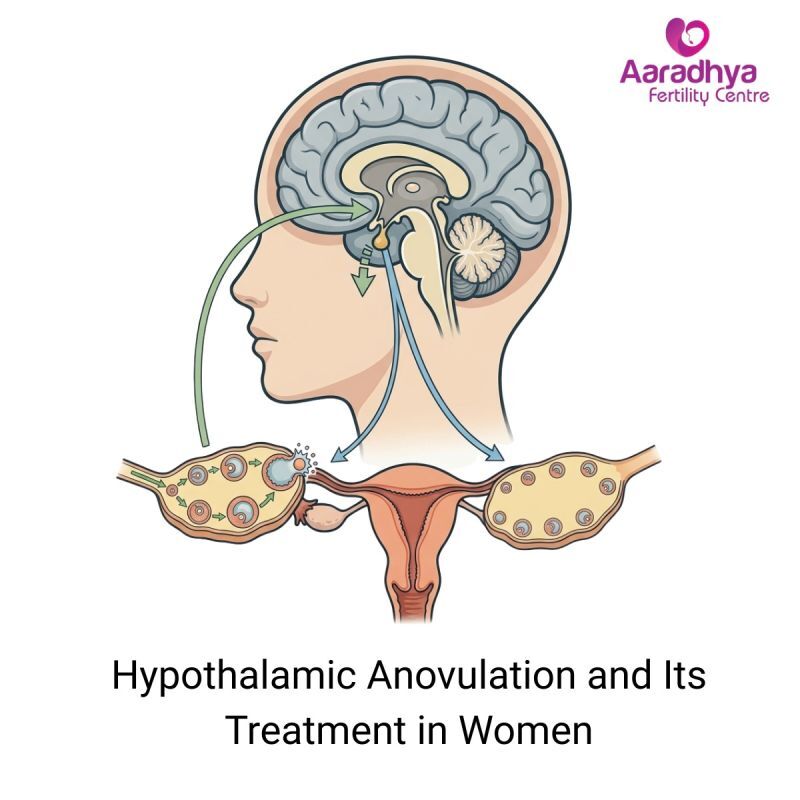
Hypothalamic ovulatory disorders (HO) account for approximately 10% of all ovulatory disorders and are classified as WHO Group I anovulation. These disorders occur when the hypothalamus does not adequately stimulate the pituitary gland, resulting in reduced gonadotropin secretion and failure of ovulation.
Causes:
Common causes include:
· Congenital conditions
· Genetic disorders
· Transient hypothalamic-pituitary-ovarian (HPO) axis dysfunction
· Surgery
· Trauma
· Radiation
Symptoms:
Women with WHO Group I anovulatory disorders commonly present with:
· Primary or secondary amenorrhea
· Delayed puberty
· Infertility associated with low sex steroid levels
Diagnosis:
Typical hormonal findings include:
· FSH ≤ 0.2 IU/mL
· LH ≤ 0.5 IU/mL
It is important to differentiate hypothalamic anovulation from PMOS. In hypogonadotropic hypogonadism, antral follicle count (AFC), ultrasound (USG) findings, and anti-Müllerian hormone (AMH) levels may not correlate. AMH levels may be either very low or elevated because of chronic anovulation.
Treatment
Gonadotropin injections are commonly used for ovulation induction. FSH is administered to stimulate follicular growth, while LH supports optimal follicular development. These injections are given over several weeks with regular ultrasound monitoring. Once the dominant follicle reaches ≥17 mm, hCG is administered to trigger ovulation.
Congenital hypothalamic hypogonadism is characterized by markedly low FSH, low LH, and low estrogen levels. A prolonged GnRH stimulation test using Triptorelin 0.2 mg may be performed. Recovery of gonadotropin secretion after prolonged stimulation (over 20 days) suggests functional hypothalamic hypogonadism.
In women with hyperprolactinemia, correcting elevated prolactin levels with appropriate medication can restore ovulation. In cases of a pituitary adenoma, surgical removal followed by ovulation induction may help restore normal ovulatory function.
Early recognition of hypothalamic anovulation is important because many women can achieve successful ovulation and pregnancy with appropriate treatment. A systematic evaluation and individualized treatment plan can significantly improve fertility outcomes.
Dr. Sarita Suresh, MD, FRM
Founder & Medical Director
Expert in Reproductive Medicine & Fertility Care
Aaradhya Fertility Center, Visakhapatnam
Author Info

No Comments